
“I Can’t Read My Own Handwriting!”

Because of my son’s speech delay he also struggled to write (same muscle family) So one part of his IEP (Individual Educational Plan) was occupational therapy (OT) in order to strengthen his hands and fingers. He had been making progress but after a couple of years, the district inexplicably determined that he no longer needed it. But his handwriting was still basically illegible! The district’s decision to cease services was unwarranted, so we called for a Planning and Placement (PPT) meeting to address our concerns and asking for them to reinstate his OT services.

For those unfamiliar with special education services; each atudent has a document called an IEP (Individualized Education Plan). An IEP is exactly as it’s named. Children are unique and each has their own requirements for what will allow them to learn. Accommodations can mean extra time for tests for those with ADD/ADHD or executive functioning deficit, large print and/or Braille texts for students who are visually impaired. There are many types of services that can be provided, these are just a few. However, many school districts would rather refuse services than provide them.

There’s an interesting article in the New York Times from 2005 (a link is below) which addresses how contentious the issue became with parents and schools. Instead of partnering together to ensure an education. Parents and districts were going to court to fight over it.

We called a PPT meeting (parents have the right to call for one; anytime). We wanted to them to explain to us why they wanted to stop the OT. After a lot of blah-blah-blah, the highlight of the meeting was when we were told that handwriting isn’t critical to students because, according to her, “everybody uses a keyboard nowadays.”

She said that with a straight face.

We countered, “what about forms? Job applications?” They just waved our concerns away but when our son was asked to speak on his own behalf, he told the room that “I can’t read my own handwriting, I can’t read the notes I take for class.”

That stopped them cold. They reinstated the OT.

The point of this story is that your child has a right to an education and the state is obligated to provide it. You have rights, you have a say, and you have choices. There are many resources at your disposal, so take advantage of them so that you can be an informed advocate for your child. The most important thing is that you accept your child’s differences and love them unconditionally. For all the challenges I’ve faced as a parent—I wouldn’t change a thing about my children.
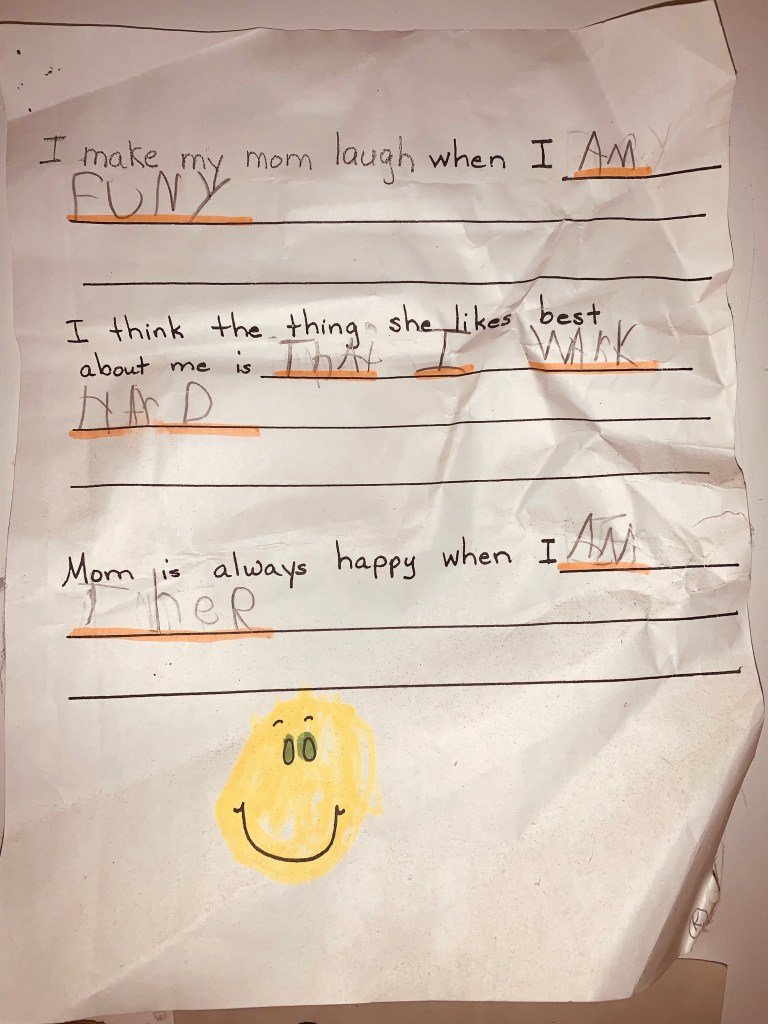
“I made my mom laugh when: I am funny,
I think the thing she likes best about me is:
I work hard; My mom is always happy when: I am there”

Continue reading →
Standard

The Great Non-Communicator

My first child, a boy, was born at a very healthy 10lbs 10oz. He was HUGE! He was the buzz of the hospital nursery. The nurses would laugh and say, “Oh, you’re the mom of the BIG baby!? We had to get diapers from the pediatric floor, because he doesn’t fit in the newborn ones!” So despite the fact that he came home wearing size 3-month clothing, he had a normal babyhood. Until at around 18 months, while playing with some playmates I realized that my son wasn’t saying words like the other boys. They said “mommy, more goose (juice)” and many other simple phrases and words. My son? Nope…sounds, grunts, pointing and showing me what he was talking about. It worked for me! My son did get very frustrated and banged his head sometimes but I still hadn’t quite realized this was a problem Fortunately for me, one of the moms decided to speak to me about her concerns. She suggested that I have him evaluated by Connecticut’s Birth to Three System. Birth to Three’s “mission is to strengthen the capacity of families to meet the developmental and health-related needs of their infants and toddlers.” I was told that they had specialists who would come into my home to evaluate my son for possible speech delay issues. Was I grateful for this kind and caring advice? NO! I was not! Like many new mothers, I was insulted and hurt because I took it personally. I was too insecure to take well meaning advice. It seemed to confirm my own worst fears; I’m a bad mom! I have no idea what I’m doing! I told myself lots of BS. He’s only 2 1/2! He’ll wake up tomorrow morning and say “Good Morning Mother!” in a clipped British accent! Or recite the Gettysburg Address at the dinner table!

Of course, I was in the river in Egypt: Denial!

After I had a week or two to calm down and think about it, I realized that she was absolutely right. No one but me (and sometimes his Dad) could understand him. He got frustrated when I didn’t understand and he couldn’t tell me what he needed or wanted! Poor guy! One morning I was in my room and I heard a quiet thunk,thunk,thunk coming up from the stairs. What was it? It was my son hauling up a gallon of milk step-by-step to show me he wanted a cup of milk. Did I mention how strong he was?

So a short time later, I got over myself and called Birth to Three. They listened to my concerns about my son and his lack of words and sounds. Two lovely therapists came out to my house a week later and spent qitesome time evaluating him. They asked about family history, my pregnancy, labor and delivery and so forth. They were kind and gentle and professional. After reviewing their findings, they determined that he did have Expressive Speech Delay–which is different (and easier to treat) than Receptive Speech Delay (which involves the brain receptors which interpret the spoken word and sounds) . My son had no problem with that, he was able to follow 2 step commands like “take your shoes off and put them by the door.”

Expressive delay is usually due to a deficit/weakening of the fine-motor muscles. So while my son could understand instructions, he couldn’t repeat them. I hadn’t realized that the tongue is a large muscle which is in charge in the formation of sounds; words and sounds. Birth to Three would provide services to our family, and our son was to attend pre-school at the STAR Rubino Center in Norwalk. Their primary focus was to work with children with speech-delay; speech impediments; mutism. I turns out that instead of being a bad mom, I was being too good a mother. I was the interpreter for my son. I understood his “words” and his approximations of language;

The Rubino Center was an answer to prayers. He spent 2 hours, twice a week in the classroom, and he saw an individual speech therapist as well. The goal was to strengthen his tongue and lips. Unlike other kids, he had a fun homework assignment; he had to drink a McDonalds milkshake every couple of days. While it’s not necessarily a healthy choice, but that think liquid going up the straw sure gave his mouth a workout! And a good incentive too!

I think his first word that I understood was “puddle” which he told me after class following a rainstorm. It was my favorite word for a long time.

A few years later, I ran into the mom who had suggested that I have my son evaluated; I apologized for my initial response to her and thanked her warmly for her help in pushing me in the right direction to get him the speech therapy he needed. I described the progress he had made thus far and that I would have waiting much longer had she not intervened. It also helped me realize that the biggest impediment to getting him help was ME! My own ego and my own insecurities, which should have been put aside.

Photo by Crystal Partridge on Pexels.com

http://www.birth23.org

http://www.starct.org

Standard